Thursday, May 3, 2018

Reclaimed

After some time stiffening up on my plaster bat, my latest batch of reclaim clay
was finally ready to pound up last night after a “slight” bit of wedging and bagging up.
I’ll let it sit for a while longer… before I start doing a “real” wedging
and actually making work out of this FREE CLAY!!!

Save

Save


from Gary Jackson: Fire When Ready Pottery https://ift.tt/2HKIkY1

Weekend Event Guide: Filmed by Bike!, Coast Gravel Epic, Cinco de Mayo grilling, and more

NW Naito Parkway. (Photo: Jonathan Maus)

The Weekend Event Guide is sponsored by Abus Bike Locks. Thanks Abus!

It’s going to be a beautiful weekend. And you never know how long this weather is going to last. Best to grab it by the horns and ride it as long as you can.

Here’s our weekly selection of the best ways to take advantage of the sun on two wheels…

Friday, May 4th

Filmed by Bike Opening Night Street Party – 5:00 pm to 10:00 pm at The Hollywood Theater
It’s the big street party bash to welcome the 16th annual Filmed by Bike festival. Held right outside the Hollywood Theater, this party is hosted by Base Camp Brewing and will include DJs from XRAY.FM, a performance by The Sprockettes, great food, and much more. More info here.

16th Annual Filmed by Bike Film Festival- 5:00 pm to 7:00 pm at The Hollywood Theatre
The great films included in this year’s festival begin playing on Friday night. There are six different movie programs and special events throughout including bike rides and filmmaker chats. Get a festival pass for unlimited access. More info here.

Saturday, May 5th

Oregon Coast Gravel Epic – All day from Waldport Community Center
Choose from two different routes — 37 or 62 miles — and explore the Oregon Coast Range via the Siuslaw National Forest. Ride is organized by Mudslinger Events and is the first event in the Oregon Triple Crown. Enjoy a Cinco de Mayo feast with friends old and new after completing the course. More info here.

Trail Maintenance Work Party at Stub Stewart – 9:00 am to 2:00 pm at Stub Stewart
Make a deposit in your karma and sweat equity account while helping keep our local trails buffed, primed, and cleared for the upcoming season. More info here.

Advertisement

5 De Mayo Ride – Grilled By Bike – 11:00 am to 6:00 pm at Mt. Scott Community Center
Join the fun-loving bike grillers for breakfast tacos in Mt. Scott Park. Bring food and/or a grill to get into the action. Ride will head towards Hollywood with another park stop for grilling before ended at the Filmed by Bike Street Party. More info here.

International Women’s Mountain Bike Day – 1:00 – 3:00 pm at The Lumberyard
NW Trail Alliance and River City Bicycles have teamed up for this beginner-friendly ride. They’ll start at The Lumberyard and then bike together to Gateway Green. This is part of a larger effort to get more women riding off-road. More info here.

Sunday, May 6th

Sauvie Island Shootout – 9:00 am at Ovation Coffee & Tea
Ready to test your legs with some of the fastest riders around? This ride is great for training into race shape and for finding new riding mates. Route loops around Sauvie Island and then heads up the west hills before rolling back to northwest Portland. More info here.

Willamette River Welcome Ride – 9:30 am SE 7th and Sellwood Blvd
Join a certified Portland Wheelmen Touring Club ride leader for this 25-30 mile jaunt along riverside bike paths and a few climbs to improve the view. More info here.

Stay plugged into all the bike and transportation-related events around the region via our comprehensive event calendar.

— Jonathan Maus: (503) 706-8804, @jonathan_maus on Twitter and jonathan@bikeportland.org

Upgrade your inbox: Sign up here to get the Weekend Guide and all our stories delivered via email.

BikePortland needs your support.

The post Weekend Event Guide: Filmed by Bike!, Coast Gravel Epic, Cinco de Mayo grilling, and more appeared first on BikePortland.org.


from Latest headlines from BikePortland https://ift.tt/2HSrW3t

Wednesday, May 2, 2018

Despite need for “safe systems” approach, crash reports still put responsibility on victims

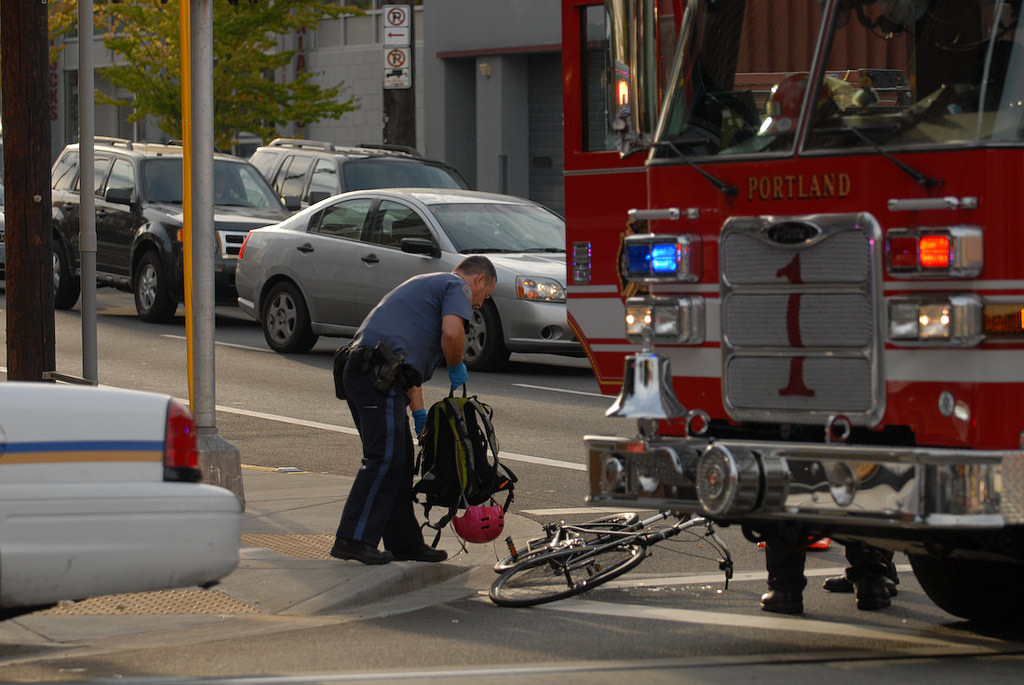
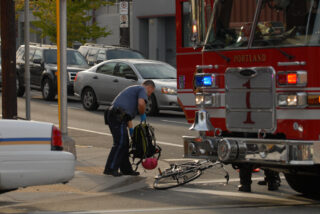
(Photo: Jonathan Maus).

This story is by Greg Spencer, a writer and editor and proud dad of two bike-commuting kids. He’s also a volunteer with the local chapter of Families for Safe Streets.

In Metro’s draft 2018 State of Safety Report, previewed last month on BikePortland, the latest regional road crash data is analyzed, and it’s done for the first time from the perspective of Vision Zero, a policy framework that aims to eliminate deaths and serious injuries.

But some of the presented data do not reflect the Vision Zero ethos, which says that road safety is a shared community burden, not one that’s primarily on the backs of crash victims.

In adopting Vision Zero, Metro set a far more ambitious safety goal than the one in its last safety report, published in 2012. It aimed at halving fatal crashes by 2035, while Vision Zero strives to eliminate them. Vision Zero, a worldwide movement originating in Sweden in the 1990s, rejects the cold, cost-benefit approach to safety investments and instead takes an ethical stand that no deaths from road crashes are acceptable. It embraces a “safe system” view in which the onus for preventing deadly crashes falls equally on traffic engineers, lawmakers, police, car companies, licensing authorities, health care workers and more.

So when I saw the draft report’s breakdown of crashes by “contributing factor,” I was surprised that almost all the factors related to road-user behavior, and that almost none dealt with pre-existing problems with the travel environment. For example, there are no factors relating to the quality of the road itself, the posted speed or the presence or absence of crosswalks.
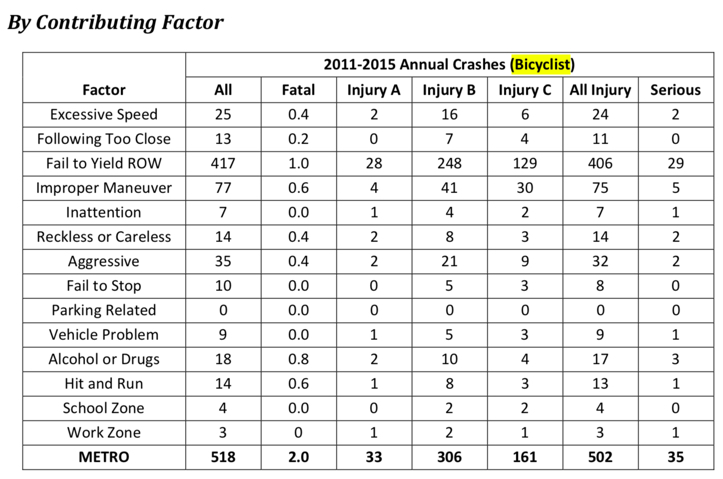
Chart from Metro’s draft 2018 State of Safety report.

These factors are based on tick boxes on official crash report forms filled in by law enforcement officers. Aside from two of the factors — “school zone” and “work zone” — they all relate to supposed mistakes or infractions committed by the individuals involved. In my judgment, this reflects an outmoded view that the roads, rules and conditions are a given — and that it’s up to road users to adapt or die. (Or “Safety is up to you”, as you can see in this currently available road-user guide from the Federal Highway Administration.)
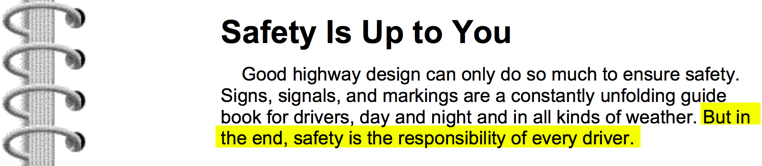
From, “Read your Road: Every Highway User’s Guide to Driving Safely,” by the Federal Highway Administration.

To be fair, the report does reflect extensively on other elements of the transport system. Although individual crash report forms fixate on road-user error, other information about crashes is recorded, and when analysed in the aggregate, patterns emerge that can inform improvements to the transport system.

For example, crash locations are documented and Metro’s draft report aggregates them to show that, for example, arterials are the most dangerous types of street in the Portland region per distance travelled — more dangerous than residential streets and more dangerous than freeways. The report highlights a positive correlation between the number of vehicle lanes on roads and frequency of crashes that occur on them. And it shows — no surprise to readers of this blog — that bicycle crashes occur at intersections much more often than in between blocks.

These points were highlighted by Lake McTighe, who manages the State of Safety report for Metro. I emailed her for a comment for this post, and she invited me for a coffee to explain Metro’s commitment to the system approach. “Contributing factors are just a part of it,” McTighe told me. “We think big steps forward are identifying locations of crashes in terms of the road classification, intersection vs. mid-block, and the number of lanes. This data also tells us whether nighttime crash locations had street lighting.”

These lessons supply useful evidence when Metro recommends such things roundabouts or timed traffic signals to make intersections more bike-friendly, McTighe said. Or when it suggests road diets that curb motor traffic by removing lanes.

Advertisement

“It’s significant that our data imply that adding lanes will have an impact on safety,” McTighe said, highlighting the tension between the need for safety and Oregon legal requirements for road capacity, aka “level of service.”

“One of the ways we’re trying to frame things is to get away from finding whose fault the crash was, and to move towards what can be done to make the roads safer.”
— Lake McTighe, Metro

Similarly, the report shows that the most serious crashes between motor vehicles are head-ons. That’s a good argument for more medians, McTighe said, pointing up Martin Luther King Boulevard as a good case study. The road, once similar to NE 82nd in terms of design and dismal safety record, was reconfigured in the 1990s with a tree-lined green median. Both streets are still counted among Portland’s “high crash corridors”, but MLK no longer has any of the city’s most dangerous intersections, while 82nd has six of them.

“One of the ways we’re trying to frame things is to get away from finding whose fault the crash was, and to move towards what can be done to make the roads safer,” McTighe said. That does sound more like Vision Zero. Even so, she agreed that the data in the draft State of Safety Report has its shortcomings. Perhaps the most glaring is the lack of speed information. The “contributing factors” include the category of “excessive speed”, but this is a relative term and not the same as absolute speed. It indicates that, according to crash-scene evidence or witness testimony, one or more of those involved was exceeding the speed limit or going too fast for conditions.

But, as stated in BikePortland’s coverage of the draft report, speed is a factor in most deadly crashes, including those where participants were traveling within the posted limit. Studies have shown a 60% fatality rate for pedestrians struck by cars going just 45 mph, a typical speed on major Portland streets. Oregon crash reports don’t even include the posted speed limit at the crash site, much less the actual speeds that cars on those streets travel at.

Part of the difficulty in getting this information into crash reports is the byzantine the way speed limits are legally recorded, McTighe said. Oregon has speed limit standards based on road classification. But local and regional authorities can set limits that deviate from those standards on a road-by-road basis. And they can change those limits over time as they see fit.

So in order to ascertain posted speeds for individual crash sites, “Someone would literally need to sift through PDFs in state records to find what was in effect at the time,” McTighe said. Or go through Google Streetview, and find posted limits in archived images.

McTighe said she would love to easily match crashes with posted speed limits, but it would require more person hours than Metro has at the moment.

Another deficiency that I pointed out is the lack of information about nearest marked crosswalks in pedestrian crashes. Media reports will often point out that a pedestrian crash victim was “jaywalking,” casting the blame squarely on the person who was struck. However, on many roads urban roads — and Portland is probably typical in the United States — marked crossings are few and far between. This does not constitute a safe system.

McTighe said one obstacle in getting location data about marked crossings is that Oregon doesn’t have a legal standard for minimum frequency of marked crossings. In fact, Oregon roads have no legal standards for safety at all — only non-binding goals at this point. What the state does have are legal standards for vehicle throughput, and this is just one of many factors that stacks the deck in favor of driving in the ongoing fight for safe streets.

— Greg Spencer

Never miss a story. Sign-up for the daily BP Headlines email.

BikePortland needs your support.

The post Despite need for “safe systems” approach, crash reports still put responsibility on victims appeared first on BikePortland.org.


from Latest headlines from BikePortland https://ift.tt/2Ib32zw

It’s silly season in Portland’s bike lanes: Please try to be nice about it

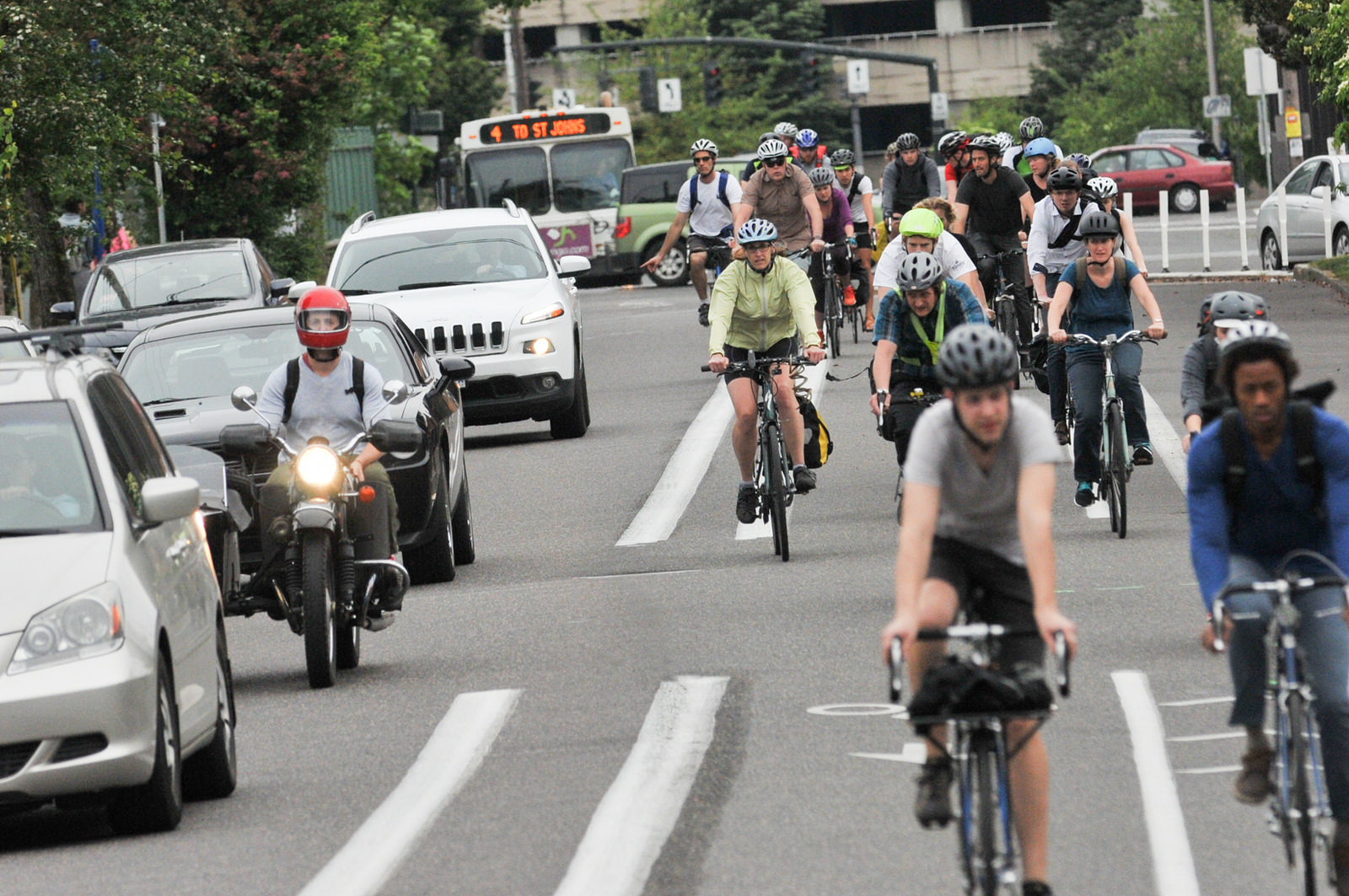
North Williams Avenue, May 3rd 2016.
(Photos: Jonathan Maus)

I received a disturbing text from a reader this morning (trigger warning: language might be upsetting to some readers):

“Got yelled at by a guy on a bike on Better Naito today. He stopped in front of me to yell at me for being selfish. Apparently I was riding too slowly because I was unsure how to cross the lane to turn left onto Oak. Two blocks later I was called a faggot and spit on. It’s chaos out there and commuter race season has begun.”

Sigh. There’s a lot to unpack here.

If you’ve lived in Portland a while you know that as the sun creeps out in spring, everything changes for cycling. Not only is it physically and mentally much more appealing to ride bicycles this time of year compared to the darkness and moisture that pervade previous months on the calendar — but there is also just so much excitement around cycling in general. Pedalpalooza planning is in full swing, it’s National Bike Month, the Bike More Challenge is on many people’s minds. And heck, this year the folks who run Biketown decided to make it free for the entire month!

And these days, with tens of thousands of new Portlanders in town (Hi! Welcome!), there are even more people using bikeways who might not be as comfortable riding and navigating around on two wheels as many of you are.

Please be nice to them!

I know people who actually change the routes they take during this time of year specifically to avoid all the dreaded “newbies” who use the popular bikeways. People wait all year for better weather. And then it gets here and they feel like they still can’t ride in peace because of all the people suddenly pedaling around in front of them. I personally don’t get that. I love the crowds! But hey, different strokes for different folks. I’m fine with that. Just don’t be a jerk about it.

Advertisement

This anti-newbie culture, made so apparent in those insults shared by our reader on his ride into work this morning, is much stronger than you think. It’s gross and I wish it would stop.

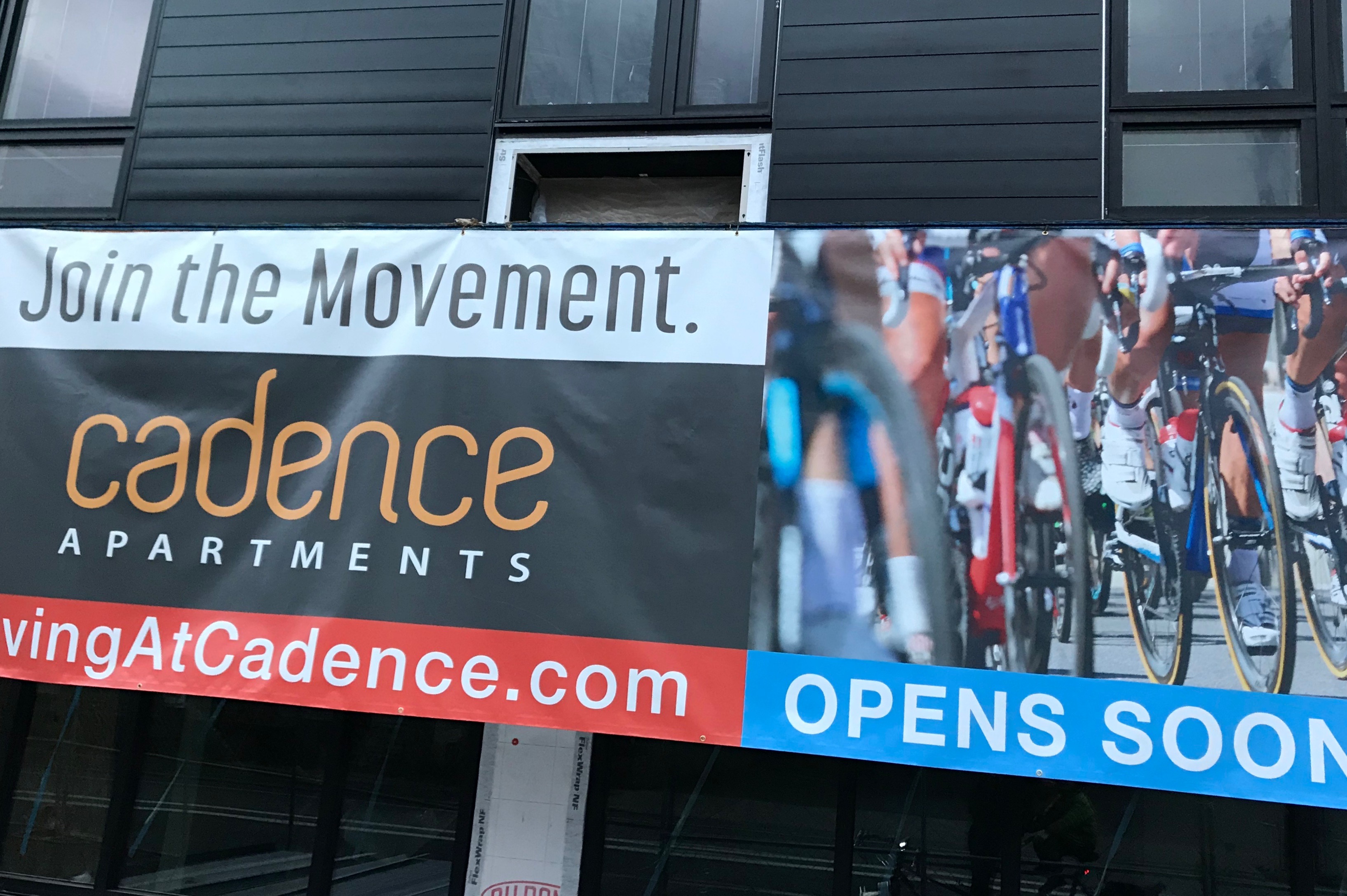
This ad for new residences on North Williams — known as Portland’s “Cat Six” corridor for the daily races that break out on its bike lanes — is not helping.

Of course it doesn’t help that our cycling culture in America is draped in the same macho, speed-is-everything-BS that our car culture also suffers from. But I digress.

After texting back to that reader what might motivate someone to be so rude, he surmised. “It’s the elite attitude of this city’s ‘ardent’ bike commuters.” I think there’s some truth to that.

Yesterday on Twitter, our Mayor Ted Wheeler happily shared a photo of himself in City Hall after biking into work. But he made a fashion choice that led @zacconklin to respond with, “Nice try Ted, looks like you wore the wrong shoes for your pedals on this photo-op. If you actually rode your bike more you would realize that.”

Wow. Tough crowd.

Maybe if we’d all just relax a bit and be nicer — you know, if we’d just ride and act the way we always hope and pray (and demand!) that people drive — then maybe our streets be the humane spaces we all want them to be.

Thanks for reading. I look forward to riding with you — no matter how long you’ve been doing it.

— Jonathan Maus: (503) 706-8804, @jonathan_maus on Twitter and jonathan@bikeportland.org

Never miss a story. Sign-up for the daily BP Headlines email.

BikePortland needs your support.

The post It’s silly season in Portland’s bike lanes: Please try to be nice about it appeared first on BikePortland.org.


from Latest headlines from BikePortland https://ift.tt/2Kvh1i5

The Foster Road project is starting: Here are the latest concept drawings

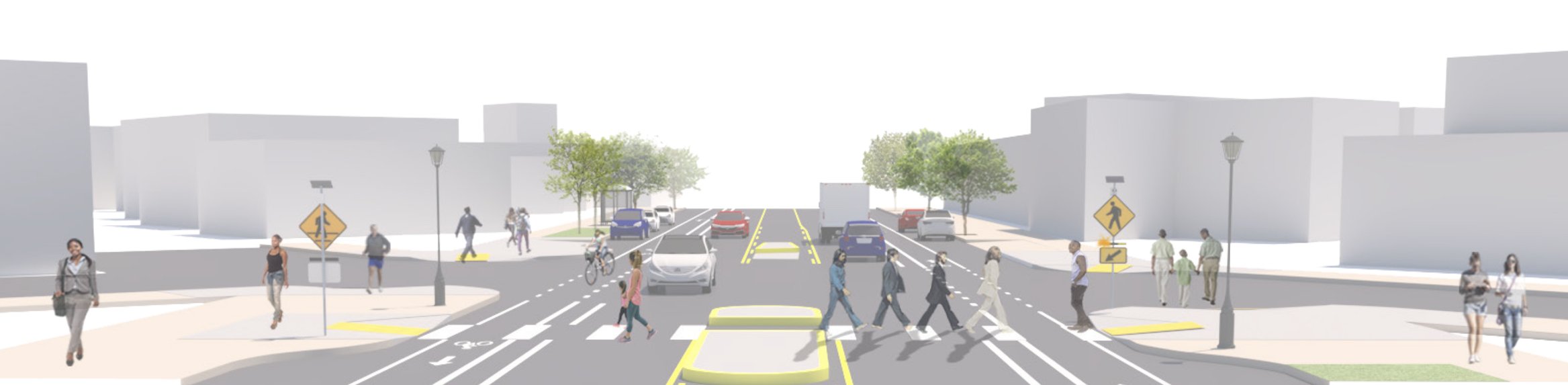
Foster at Gladstone. (Insert witty Abbey Road reference here.)

It’s finally happening.

The Portland Bureau of Transportation has mailed out notices to residents that the Foster Road Streetscape Project will be breaking ground in a matter of weeks. This is right in line with what we reported back in January so it’s a good sign that the project is moving ahead as planned.

Of course it’s been 15 years since the Foster Road Streetscape Plan was passed by City Council, and four years since the City Council unanimously approved the project itself. But let’s focus on the positive: This $9 million project ($5 million from federal government, $4 million from various City of Portland sources) will completely redesign this key corridor from SE 50th to 90th and repave the street between 82nd and 90th.

In one of the final administrative steps at their April 25th meeting, City Council accepted the $5 million bid from the private contractor (which was, shockingly, lower than city engineers estimated).

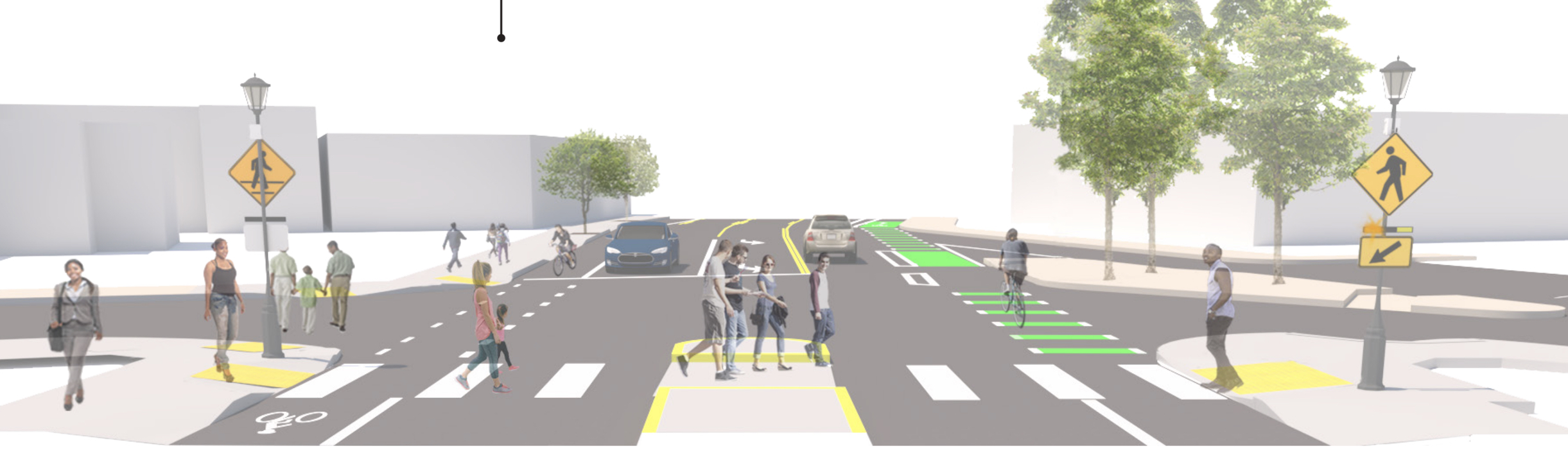
Another update since we last covered this project are new concept drawings released by PBOT that give us our best view yet about what we can expect.

For the bikeway, in stretches where on-street auto parking exists the bikeway will be 7-feet wide including a painted buffer zone. When there is no parking, the bike lane will be six feet wide. None of the bikeways will be physically protected from other road users.

Here’s the view at 84th:

Foster at 84th.

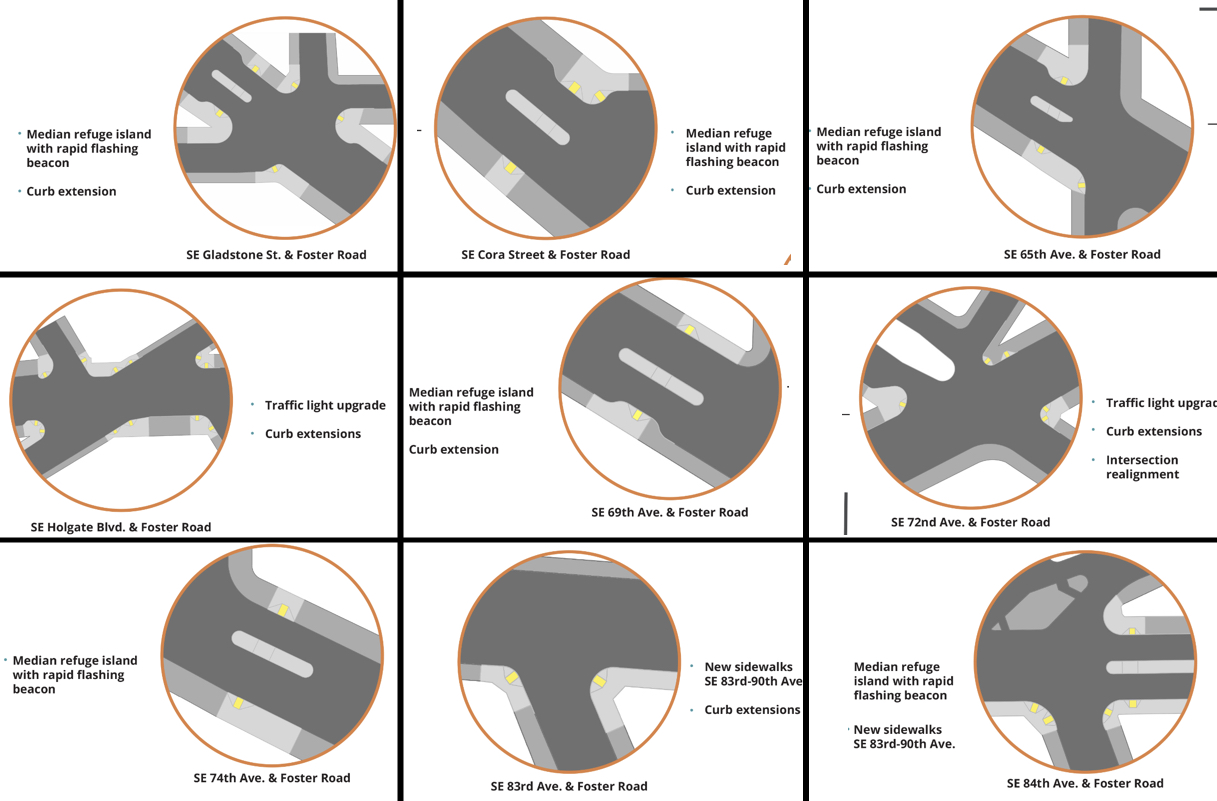
In total, nine intersections will be updated with a variety of changes including things like new crossings, curb extensions, new sidewalks, and so on. Six locations — SE 58th, SE Mall, SE 65th, SE 69th, SE 74th and SE 84th Ave — will get new median refuge islands with rapid flash beacons.

Other upgrades in the corridor corridor include: 9-foot wide sidewalks (from existing 5-foot) between 83rd and 90th, 190 new street trees, decorative street lights, 69 ADA-compliant curb ramps, and modern signals. “The project will transform Foster Road into an inviting thoroughfare,” PBOT promises on their website. “That supports a vibrant commercial district and enhances the quality of life in the surrounding neighborhoods.”

Advertisement

To say this is a high-profile project for PBOT is a vast understatement. Given that there are some critics already, and simply because Foster is such a busy, growing, and marquee street to begin with, the project will be highly scrutinized. As such, PBOT seems to be pulling out all of the stops to make sure everyone is happy. The official word is that the project, “Will deliver a street that is safer and more attractive for people walking, biking, taking transit and driving.” (We’re not sure which adopted City of Portland goal says any project should make driving more attractive.)

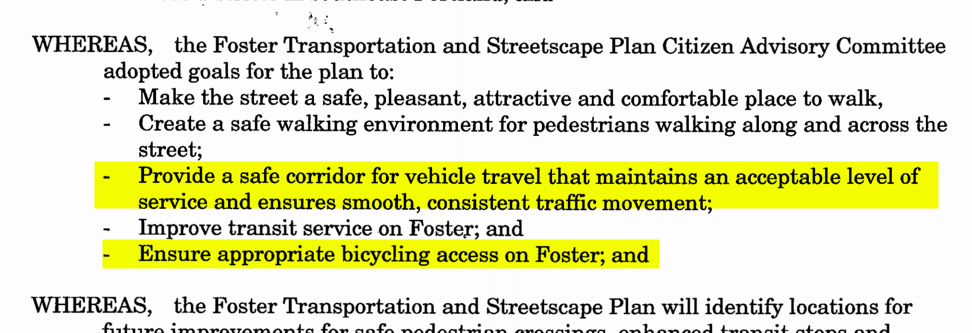
Keep in mind that when the plan was passed by City Council in 2003, the ordinance language said the goals were to, “Provide an acceptable level of service [for vehicle travel] and ensures smooth, consistent traffic movement.” And no, they were not referring to human-powered vehicles. In the same ordinance, another goal stated, “Ensure appropriate bicycling access on Foster.” They didn’t define “appropriate,” but we all know what that means.

The council ordinance adopted in 2003.

Back to the verbage being used today, the City says, “The changes to the street and urban design will transform Foster Road from a high speed, auto-oriented corridor into a more balanced streetscape that is safer and more accessible for people walking, biking, taking transit and driving.”

PBOT expects the change going from four lanes for driving to two (plus a center turn lane) will reduce the crash rate by 20 to 50 percent. The newly configured standard lanes will be 10-feet wide.

We can’t wait to see how this all shakes out.

The City says construction will last 6-7 months and they hope to have it completed before winter.

Do you live and/or ride in this area? How are you feeling about all this?

— Jonathan Maus: (503) 706-8804, @jonathan_maus on Twitter and jonathan@bikeportland.org

Never miss a story. Sign-up for the daily BP Headlines email.

BikePortland needs your support.

The post The Foster Road project is starting: Here are the latest concept drawings appeared first on BikePortland.org.


from Latest headlines from BikePortland https://ift.tt/2jp9tBe

Magnificent Magnolias

A sure sign of Spring when the star magnolias start to bloom.
Love these flowers… too bad they are so fleeting & short-lived!


from Gary Jackson: Fire When Ready Pottery https://ift.tt/2HIY2Tz

Anxiety Awareness for Mental Health Awareness Month

May is Mental Health Awareness Month. Read this for information to increase anxiety awareness. Learn about anxiety disorders, panic attacks, OCD, and more.To celebrate Mental Health Awareness Month, let’s shed some light on anxiety. After all, anxiety affects everyone. Every human being on this planet, across cultures, genders, age groups, socioeconomic groups, and all other groups of people, experiences anxiety. To be sure, not everyone has an anxiety disorder, but anxiety itself is part of the human condition. Therefore, it makes sense that during Mental Health Awareness Month we increase our awareness of anxiety. By doing so we celebrate. We celebrate being human and having the ability to take charge of our mental health despite anxiety.

What to Know About Anxiety for Mental Health Awareness Month

Anxiety is complex. It takes many forms, and it affects people in different ways. Some facts about anxiety:

It can be good. It can motivate. It can ensure we survive by kicking the       fight-or-flight response into gear when necessary.

When you feel anxious but can continue with your life as usual, you don’t meet the criteria for an anxiety disorder.

There’s a difference between a panic attack and an anxiety attack. Panic attacks happen out of nowhere (there’s probably a trigger, but it’s not obvious), or because someone is anxious about having another panic attack. Anxiety attacks, on the other hand, occur in the context of a worry, fear, or very stressful situation.

Obsessive-compulsive disorder (OCD) was classified as an anxiety disorder until 2013. Now it has its own section in the Diagnostic and Statistical Manual of Mental Disorders (DSM-5), but it still has a very significant anxiety component. Obsessions, or thoughts, are anxiety-provoking. Compulsions, or behaviors, are things done to reduce the anxiety.

Separation anxiety disorder is often thought of as a disorder just for kids, such as young children who become upset when they have to be away from their parents or caregivers. Adults can actually have separation anxiety, too. It often happens in times of transitions or periods of adjustments.

Social anxiety involves an intense fear of being judged and/or of embarrassing oneself in front of others. It has nothing to do with being an introvert or an extrovert. Introversion and extroversion are personality traits that have to do with where someone gets his or her sense of energy (from within themselves or from being with others). Both introverts and extroverts can have social anxiety.

A specific phobia is an intense fear of something, some place, or some situation. The fear is so gripping that people cannot get around it.  People with specific phobias know that their fear is irrational, but they’re stopped by it anyway.

All anxiety can stop people from moving forward. The reason people can’t move past any type of anxiety, at least at first, is because anxiety is all-encompassing:

  • It operates at the neurochemical level of the brain, and many different regions of the brain are at work in anxiety
  • It can take over our thoughts
  • Anxiety is also a powerful emotion
  • It tries to control our actions

Being aware of the nature of anxiety and anxiety disorders during Mental Health Awareness Month and beyond is empowering. It leads to increased awareness of the nature of anxiety. Knowledge is power, and armed with knowledge, you can beat anxiety.

Next time, we’ll increase awareness about overcoming anxiety. It’s part of the Mental Health Awareness Month celebration.

In the meantime, what do you want people to know about anxiety to raise awareness? Share your thoughts in the comments.


from Anxiety-Schmanxiety – HealthyPlace https://ift.tt/2JNqznA