Friday, April 27, 2018

Editorial: Freeways, the future, and Mayor Ted Wheeler

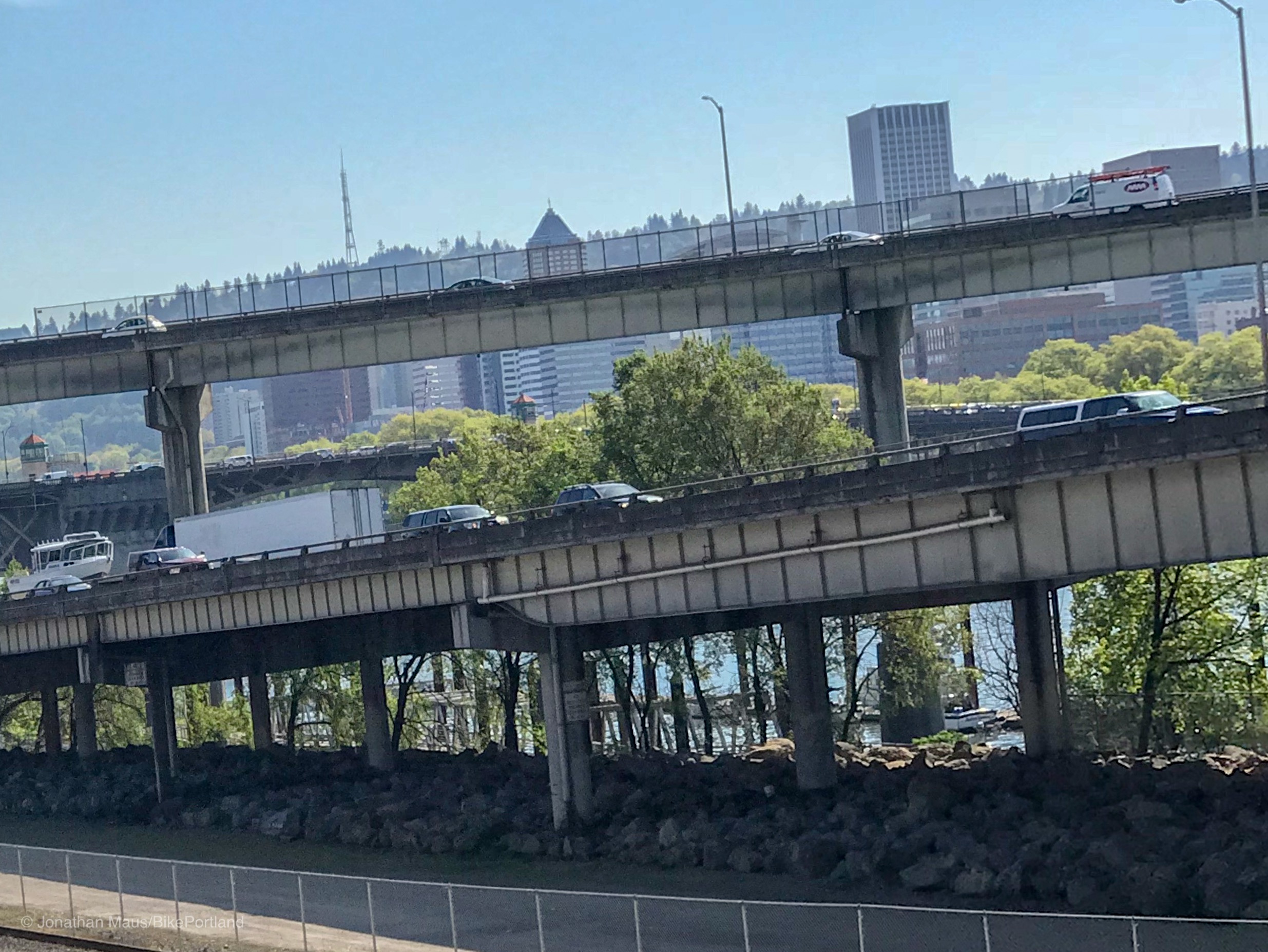
Mayor Ted Wheeler supports an ODOT megaproject that invests hundreds of million of dollars in more of this.
(Photos: Jonathan Maus)

When it comes to transportation, recent statements from Portland Mayor Ted Wheeler paint a confusing picture of the future.

On one hand, Wheeler seems to understand the urgency of climate change. On the other hand, he supports the I-5 Rose Quarter project that adds lanes to a freeway to improve driving conditions in our central city.

On one hand, he understands that the future of transportation is in flux. On the other hand, he supports single-occupancy vehicle use — a form of urban transportation whose time has long since passed.

Confused or simply wrong, Wheeler — someone who is ostensibly a progressive — is on the wrong side of this issue.

Ted Wheeler, March 2018.

Cars are ruining our cities,” is the blunt but accurate headline of a New York Times op-ed published this week. It’s an excellent summary of why investing in new freeway lanes — especially in urban areas like Portland’s Rose Quarter — is complete and utter folly.

And that’s just one recent article that demonstrates how the Overton Window on freeway expansion as a salve for congestion is beginning to shift. This is due to many factors, key among them is a growing awareness that the transportation sector continues to hemorrhage greenhouse gases while being largely ignored by politicians — even Democrats like Wheeler.

Last week ClimateWire published an article titled, “Cars threaten climate goals in blue states“, which included this passage: “Liberal states’ carbon-cutting plans are stuck in traffic. Transportation emissions [which are 54 percent of total GHG emissions in Oregon] threaten to undercut blue states’ climate goals, raising questions about their ability to lead U.S. climate efforts at a time when the federal government is rolling back environmental regulations.”

But wait, I’m a “climate change mayor” Wheeler would contend.

To which journalist and activist Alissa Walker would reply, as she did in an article on Curbed.com this month, “You can’t be a ‘climate mayor’ if you’re making more room for cars. Sorry — that’s not how it works.” “If these 402 U.S. mayors are truly adhering to the goals set forth in the Paris climate accord,” she continued, “then none of them can build infrastructure that encourages more emissions by more cars and trucks.”

Advertisement
And don’t let ODOT’s PR spin fool you: The I-5 Rose Quarter project is an attempt to alleviate congestion by adding lanes to a freeway. ODOT can claim it’s about safety and “operational improvements,” but their official infographic on the $5.3 billion transportation plan that includes funding for the project makes it clear: “Relieving congestion bottlenecks will help people get where they want to go quickly and reliably. New lanes on I-5 at the Rose Quarter will save motorists 2.5 million hours wasted in gridlock each year.”

And Wheeler himself doesn’t even try to hide it.

He was asked about the project during an interview on KATU News (Portland ABC affiliate) on April 15th.

KATU reporter:

“As we talk about congested freeways, some would argue against expanding freeways. What would you say to those who say we shouldn’t be adding lanes to area highways?”

Mayor Wheeler:

“Well, you know, highway expansion generally, like building a Mt. Hood freeway, I would agree with them in that case. The lightning rod has really been the work that’s been proposed around the Rose Quarter. That is, two auxiliary lanes that are predominantly going to be built to fix the problem there with the bottleneck. You have several lanes going down to fewer. And you have two ramps coming on, and one going off. So this [project] is going to create auxiliary lanes to help things speed through there a little bit better and actually reduce the number of accidents. So I’m very supportive of that project.”

I’m not sure what’s more disappointing: That Wheeler parrots ODOT talking points and is fooled by the agency’s sly, modern-day tactics to build mega-projects — or the fact that he appears to not understand the connection between investing in urban freeways and increased greenhouse gas emissions, air pollution (Portland ranks 32nd in the nation for worst air pollution), or the role interstate freeways continue to play in the “structured inequality” of our country.

But don’t take it just from climate change experts or journalists. Even Portland-based high-tech CEO Nat Parker is on the opposite side of Wheeler on this issue. “You can’t build your way out of congestion,” the leader of Moovel, an urban mobility company, said in a recap of the TechFestNW event in The Willamette Week earlier this month. “People will drive more if they think there is more room to do so.”

Fortunately there’s a shred of hope. Wheeler is young and seems to be open to change. At a city council meeting on March 15th he shared a version of the future that appeared to look beyond the car-driving status quo:

“I don’t think we know sitting here today what the transportation situation is going to look like even 15 years from now. Those who follow transportation planning believe we are literally right on the edge of a transportation revolution which could shift the demand for parking. It could shift the kind of infrastructure investments we need to make. It could shift the whole question of mobility for people who live with disabilities or older adults. I would be very reluctant to lock ourselves in today. It would sort of be like locking ourselves into an IBM Selectric in 1984.”

(Yes! More of this please! And just FYI, carrying ODOT’s water on a freeway expansion project is the very definition of “locking ourselves in.”)

Unfortunately, that statement came during a presentation about a new master plan for Washington Park. Ironically, Wheeler should take a closer look at that plan for Portland’s marquee park and apply its principles to the central city: Put people and safe, healthy mobility first; push driving to the outskirts; invest in transit and protected bikeways; and create entire areas where there’s no driving allowed at all.

The future of Portland — and to some degree Wheeler’s legacy — depends on building a better city. Not on building a better freeway.

— Jonathan Maus: (503) 706-8804, @jonathan_maus on Twitter and jonathan@bikeportland.org

Never miss a story. Sign-up for the daily BP Headlines email.

BikePortland needs your support.

The post Editorial: Freeways, the future, and Mayor Ted Wheeler appeared first on BikePortland.org.


from Latest headlines from BikePortland https://ift.tt/2HzEKff

A New Perspective on Anxiety Shifts Your Relationship

What's your perspective on your anxiety? How you see anxiety affects your relationship with it, your thoughts, emotions, actions. Consider: No mud, no lotus. What is your perspective on anxiety? Beyond that, what is your relationship with your anxiety? When we live with anxiety, whether it’s occasionally or constantly, it’s quite normal to struggle against it and fight, argue, and curse it—all in an attempt to make it go away. From this perspective, anxiety can be an abusive bully or a prison guard. Viewing anxiety this way leads to thoughts and emotions that are rooted in anger, resentment, and other negative reactions that affect your actions. Shifting your perspective and relationship with anxiety can do wonders for how you feel and live your life.
Perspective is Powerful

In this case, perspective relates to your opinion of your anxiety. Without thinking too much about it, do this quick exercise:

  • Name three words that describe the anxiety that you’re living with.
  • If your anxiety were a living being, what would it be?
  • What color is your anxiety?
  • What shape is it?
  • In one or two sentences, describe what anxiety is doing to you/your life.

In most cases, people’s responses are pretty negative. Anxiety isn’t seen as favorable or a positive presence. We remain stuck in the negative. Unfortunately, what we visualize—our perspective on anxiety—becomes our relationship with anxiety. We think and feel and act with that anger and resentment and hatred. We can’t break free. We can’t move forward into our lives.

Having a negative perspective on anxiety reinforces It because your thoughts are negatively oriented. Does this mean that you must start loving anxiety and seeing it as fuzzy baby animals? No, it does not. Your mind would see right through that and would continue to lock horns with anxiety. You’d still be trapped and miserable, and anxiety would still be your prison warden.

No Mud, No Lotus

A liberating perspective on anxiety is represented by the Buddhist phrase, No Mud, No Lotus.

The beautiful lotus flower, resting peacefully among the lily pads on a pond, comes from one place and only one place: the cold, oozing, sticky-yet-slick, mud on the pond floor. From the depths of the pond, through the ooze and the muck, grows the lotus. Up, up it stretches, moving ever forward. Finally, it bursts up through the surface of the pond and unfurls, gradually opening itself to the sunshine.

What would have happened if the lotus flower had cursed the mud? Viewed it as a prison warden? It would have fought and become tangled. It would have become stuck. The relationship would have been one of captor and captive. The lotus might never have burst past the surface to open to the sun and relish in the beauty around it.

Prisoner, or Lotus?

You have probably figured out that the lotus is you. The cold mud that attaches and sucks like a leach is your anxiety. How wonderful that you have a choice. You can visualize your anxiety as a prison guard and, fueled by negative thoughts and emotions, fight to be free but remain stuck in the struggle. Or you can see your anxiety as the lotus sees the mud.

The lotus’s perspective on the mud is one of appreciation. Without the mud, the lotus would wither and die. The mud is what allows the lotus to grow. The mud makes the lotus strong. No mud. No Lotus.

Return to the above assessment. Try answering those questions again, this time from the perspective of the lotus to the mud. Next, visualize yourself as a lotus and anxiety as your mud. It’s no longer your prisoner guard, and you have some wiggle room to begin to rise despite the mud. Visualize what you, the lotus, will look like, feel like, and act like.

With your new perspective and relationship with anxiety, you’re a bud unfurling.

I share another metaphor for anxiety, perspective, and growth in this video. I invite you to tune in.


from Anxiety-Schmanxiety – HealthyPlace https://ift.tt/2HzGipg

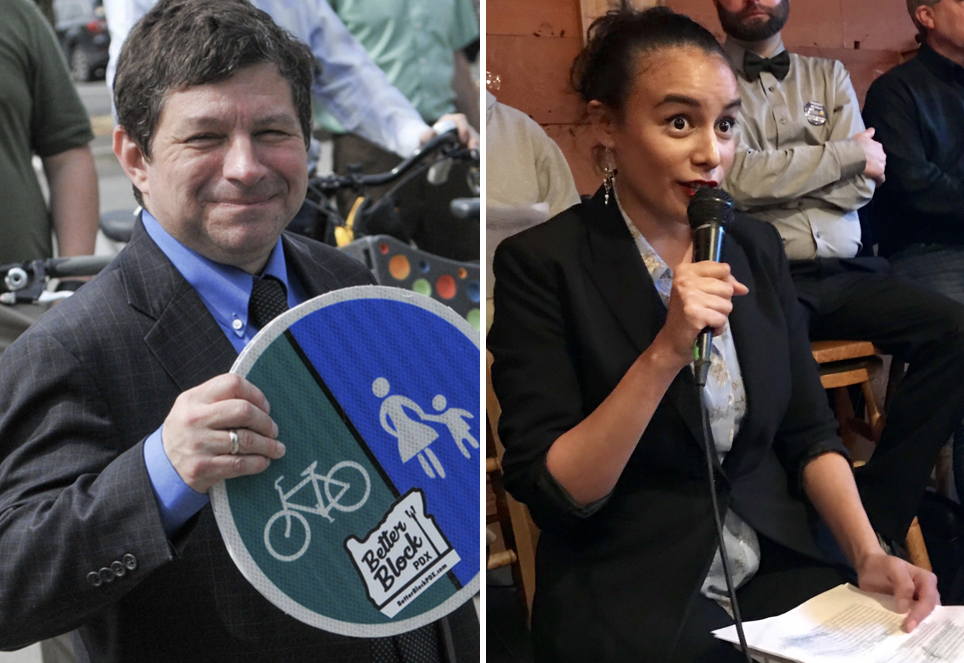
Guest Opinion: I’m Steve Novick and I endorse Andrea Valderrama for Portland City Council

Former Commissioner Steve Novick at a 2016 event and Andrea Valderrama at a candidate forum earlier this month.
(Photos: Jonathan Maus)

Steve Novick was a Portland City Commissioner from 2013 to 2017.

After having the pleasure of having her serve on my staff for four years as city commissioner, today I’m writing to the readers of BikePortland.org to officially announce and explain my endorsement for Andrea Valderrama for Portland’s City Council race. Quite simply, my experience of working with her has left me convinced that she’s the candidate you should vote for if you’re interested in demonstrable improvements to the safety and livability of our streets, our region’s ongoing housing crisis, and how these issues relate to climate change, public health and equity.

It’s evident this is a candidate who has spent time in the trenches, can speak the alphabet soup of acronyms and jargon among the best of them, and understands not only the imperative to reconfigure our streets for better outcomes, but also the mechanisms and to do so.

My endorsement of Andrea isn’t merely an exercise in championing Andrea’s accomplishments, achievements and integrity (although I will do so shortly), but is explicitly predicated on my experience as a former Portland City Commissioner, one who was responsible for the Portland Bureau of Transportation throughout my term. Having sat behind the dais, it’s clear to me that Andrea’s skillset uniquely matches both the requirements of the job and the specific challenges Portland faces.

Overseeing PBOT put me and my staff on the immediate frontlines in regards to the daily nuances of bike lanes, snow plows, and myriad of interagency compromises that define the daily workings of a 750-employee organization with a $310 million annual budget, responsible for $8.4 billion worth of infrastructure. As I wrote in Willamette Week last year, Portland’s unique Commissioner form of governance creates some perverse and counterintuitive incentives for politicians and bureaus that stymie genuinely thoughtful attempts to improve municipal services. I learned all of this firsthand, and I suspect many of you reading this blog followed along, as PBOT fought for more funding to address thirty years of deferred road maintenance, stronger policy initiatives for safe routes to school, and investments in sidewalks in East Portland. I’m proud of our accomplishments (which include launching BIKEtown, passing the gas tax and a Vision Zero resolution) but traffic fatalities continue to rise, congestion is getting worse, and we still have plenty of potholes to fill.

Each Commissioner is directly accountable to specific public, private and nonprofit sector constituents related to their bureau. The art of “getting to three votes” frequently involves complicated negotiations, particularly if you want to stand up for historically disenfranchised groups like tenants, transit riders, and/or East Portlanders. What I see as the structural, cultural and budgetary limitations to improving Portland’s transportation system color my understanding of the sort of leader the city needs. They need to embody a competent, policy-fluent, justice-minded, results-driven leadership that is necessary to not only govern despite these onerous realities but build support for efforts for reform. It’s easy enough to serve platitudes and bromides about the extent to which a candidate would be a “champion” for housing affordability, police accountability, equality and justice —the reality is, it’s harder to demonstrably live that leadership, as it pertains to the combination of nuance, wisdom, and guts necessary to win those three votes.

Advertisement

Fortunately, anyone that’s worked with Andrea can tell you — she’s lived it. If you read her responses to the question posed at last month’s transportation forum, it’s evident this is a candidate who has spent time in the trenches of these conversations, can speak the alphabet soup of acronyms and jargon among the best of them, and understands not only the imperative to reconfigure our streets for better outcomes, but also the mechanisms and to do so.

Andrea has time and again proven herself more than capable at navigating bureaucracies, community advocates, and policy.

Andrea was a significant proponent of the improved sidewalks and crosswalks on 122nd, a crucial element of the Fix Our Streets program resulting in frequent bus service on the major East Portland arterial. This sort of governing work is unsexy, arduous, and rarely appreciated. Andrea proved to be incredibly effective when it came to being able to speak wonky code with TriMet bureaucrats, listen empathetically to diverse community voices, collaborate with PBOT to prioritize projects to fund with new revenue, and advocate for political time and capital be invested in justice-minded, cost-efficient outcomes. Her continued collaborative work with the East Portland Action Plan, TriMet, and PBOT helps ensure that the gas tax would fund the necessary infrastructure providing East Portland the first frequent-service north/south bus line in decades.

Andrea’s policy acumen is similarly on display in the successes of the Foster Streetscape Project [which will start construction this summer]. Her leadership led to a bureau-wide realignment for how community engagement work is conducted. Despite strident opposition, the end result is one for which the city should be proud. Upon completion, the City of Portland will build a major safety investment in a High Crash Corridor that has seen numerous fatalities. Small businesses will enjoy a more walkable environment to entice shoppers. Southeast Portlanders will have increased transportation options. Win-win-win.

These examples of Andrea’s leadership, thoughtfulness and project management are recognized by community advocates that have had the pleasure of working with her. She’s been a dedicated voice for change at the David Douglas School District, where she serves as a Board Member; it’s not exactly an easy lift to get a unanimous vote for birth control funding from an East Portland school board, but she pulled it off. She’s likewise received accolades from her work in the Mayor’s office on the Sanctuary City resolution. Andrea has time and again proven herself more than capable at navigating bureaucracies, community advocates, and policy. That she’s built this illustrious list of accomplishments while co-parenting her beautiful, spunky daughter speaks volumes to her tenacity, commitment to values, and inherent humanity.

A city commissioner by herself can’t promise to immediately implement a permanent Better Naito, all of PBOT’s proposed Enhanced Transit Corridors, fight ODOT’s senseless freeway expansion, or raise taxes on the wealthy to fund Youthpass. That level of Sin City-esque dictatorship is simply not within the job description (again, the whole thing about getting to three votes). But a city commissioner can govern in such a manner that the advocates, rabble rousers, and community members desperately clamoring for full-fledged solutions to our housing, transportation, and police accountability issues are given full administrative attention and support. That takes a different type of leadership — one that I’m confident Andrea will deliver.

— Steve Novick


Publisher’s note:

Valderrama is running for City Council position number three. Learn more about all the candidates here. For more coverage don’t miss our recap of the recent candidate forum on transportation. For another look at this race, read the Willamette Week’s endorsement of Valderrama’s competitor Jo Ann Hardesty.

If anyone else has endorsements they’d like to publish, drop a line and we’ll consider it.

– Jonathan Maus

Never miss a story. Sign-up for the daily BP Headlines email.

BikePortland needs your support.

The post Guest Opinion: I’m Steve Novick and I endorse Andrea Valderrama for Portland City Council appeared first on BikePortland.org.


from Latest headlines from BikePortland https://ift.tt/2HxoMGk

Jobs of the Week: The eBikeStore and TriSports

Two fresh jobs posted this week.

Learn more about each one via the links below…

–> Mechanic and Sales – The eBike Store

–> Sales Associate – Trisports

Advertisement

For a complete list of available jobs, click here.

Be the first to know about new job opportunities by signing up for our daily Job Listings email or by following @BikePortland on Twitter.

These are paid listings. And they work! If you’d like to post a job on the Portland region’s “Best Local Blog” two years running, you can purchase a listing online for just $75. Learn more at our Job Listings page.

— Jonathan Maus: (503) 706-8804, @jonathan_maus on Twitter and jonathan@bikeportland.org

Never miss an opportunity. Sign up for our Job Listings email.

BikePortland needs your support.

The post Jobs of the Week: The eBikeStore and TriSports appeared first on BikePortland.org.


from Latest headlines from BikePortland https://ift.tt/2HtyJVc

Thursday, April 26, 2018

ODOT unveils draft rules for spending new Safe Routes to School funding

A family makes their way to Beach School in north Portland on the Concord Neighborhood Greenway.
(Photo: J. Maus)

One of the bright spots in the $5.3 billion transportation package passed by the Oregon Legislature in 2017 was annual funding dedicated to Safe Routes to School.

House Bill 2017 (which the Oregon Department of Transportation now calls the Keep Oregon Moving program), included a $10 million annual investment in street safety projects within a one-mile radius of schools. That number bumps up to $15 million a year in 2023.

But when the ink on the bill dried, there remained a lot of things to figure out. Who would be eligible for the money? What would the grant process look like? Which type of roads and projects would compete best for the funds?

To answer these and other questions, ODOT convened a Safe Routes to School Rulemaking Advisory Committee. The bulk of that committee’s work is done and yesterday ODOT announced that the draft rule update for the new Safe Routes to School Fund is ready for public scrutiny.

“We’ve heard from many communities that the high cash match requirement is a deterrent, and we hope to see a legislative fix to this unnecessary hurdle.”
— Kari Schlosshauer, Safe Routes to School National Partnership Senior Policy Manager

The proposed rule divides the Fund into three grant programs: Competitive, Rapid Response, and Project Identification. The Competitive grant program will use 87.5 percent or more of the total available funds and will go toward building street safety projects, “to reduce barriers and hazards for children walking or bicycling to or from schools.” Up to 10 percent of the fund will go toward Rapid Response projects to be used, “for urgent needs or systemic safety issues that occur in between Competitive Program Grant cycles.” And the 2.5 percent of the funds set aside for Project Identification grants will be used by ODOT staff to help community select eligible projects.

Another important function of the rulemaking process is to clarify definitions of words and phrases used in the rule so that grant seekers and ODOT speak the same language. The most noteworthy of these is that the committee has defined “priority safety corridor” as having:

Either the posted or 85th percentile speed is 40 miles per hour or greater; or two or more of the following exist: Speed limit 30 miles per hour or greater; More than two lanes or a crossing distance greater than 30 feet; 12,000 or greater annual average daily traffic; Has a demonstrated history of crashes related to school traffic.

With such a specific definition, there are many potential projects on streets that won’t meet those standards. If an applicant proposes a project that’s not on a “priority safety corridor,” the project might still be elibile, “if the applicant can demonstrate a significant safety risk through data or research.”

As for who’s eligible for funding, the rule clarifies that grant applications can be submitted by cities, counties, ODOT, tribes, and transit agencies. The projects must be either already listed in a planning document and/or supported by the school district.

Advertisement

Note that ODOT itself is eligible to receive funding through this program. That could make for an awkward selection process when ODOT is competing with local agencies for funding. That’s something for advocates to keep an eye on.

The be considered for selection, a project must, “Provide safety improvements that reduce barriers and hazards to children walking or bicycling to and from school.” Project types can include (but are not limited to), “creation of or improvements to sidewalks or bicycle lanes, reductions in vehicle speeds, and improvements to pedestrian and bicycle crossings.”

An unfortunate part of the sausage-making from the 2017 legislative session resulted in a stipulation applicants must provide a cash match of at least 40 percent of the project’s cost. That’s a big chunk of change that’s liable to prevent some entities from participating. Thankfully the rule includes a provision that will reduce the match to 20 percent if a school is in a city with fewer than 5,000 people, if the project reduces hazards within a priority safety corridor, or if the school qualifies for Title I treatment.

Asking for local agencies to pony up precious dollars to keep kids safe while walking and biking to school isn’t a good luck for an agency willing to throw billions of dollars at unneccessary highway expansion mega-projects. The cash match requirements concerned both of the Safe Routes advocates who shared their thoughts with us about the new rule.

Safe Routes to School National Partnership Senior Policy Manager Kari Schlosshauer is on the rulemaking advisory committee. She told us her organization is excited to see dedicated funding for Safe Routes and they’re focused on making sure it gets to the schools with the least amount of existing resources. “Unfortunately,” Schlosshauer added. “We’ve heard from many communities that the high cash match requirement is a deterrent, and we hope to see a legislative fix to this unnecessary hurdle.”

The Street Trust Advocacy Director Gerik Kransky echoed that sentiment. “We remain concerned about the high match requirements of the new program,” he shared with us via email yesterday. “And while we won’t be able to address those concerns through rulemaking we will be creating a strong public record on the issue so we can continue our campaign to expand and improve Oregon’s new SRTS infrastructure program by making it more accessible in low income communities that need it most.”

ODOT will accept public comments on the draft rule from May 1 – 31. You can send them to Safe Routes to School Program Manager LeeAnne Fergason via email at LeeAnne.FERGASON [at] odot.state.or.us. A public hearing will take place in Salem on May 15th, the Oregon Transportation Commission will consider the rule at their meeting on July 19th, and barring an unforeseen hurdles, the new rules would go into effect on July 23rd.

If you plan to solicit funding through these new grant programs, ODOT is hosting a series of workshops around the state starting in June. The Portland region workshop will take place on July 2nd. See the full list here.

Other helpful documents:
–> Safe Routes to School Fund: Overview of Draft Rule Update (PDF)
–> Notice of Proposed Rulemaking (PDF)

— Jonathan Maus: (503) 706-8804, @jonathan_maus on Twitter and jonathan@bikeportland.org

Never miss a story. Sign-up for the daily BP Headlines email.

BikePortland needs your support.

The post ODOT unveils draft rules for spending new Safe Routes to School funding appeared first on BikePortland.org.


from Latest headlines from BikePortland https://ift.tt/2FhqDct

Weekend Event Guide: Architecture exploration, women’s track clinic, Grant Petersen, and more

Rolling toward fun.
(Photo: J. Maus)

The Weekend Event Guide is sponsored by Abus Bike Locks. Thanks Abus!

Hopefully the warm and dry weather we’re having holds up for a few more days so the weekend riding can reach its full potential.

Check out our selections for things to do with your bike this weekend — which we’ve decided should start tonight!

Thursday, April 26th

Bike Bingo – 6:00 pm to 8:00 pm at Radio Room
Get prepped and hyped for the 16th annual Filmed By Bike (May 4-6th) with a fun bout of bingo on Alberta. More info here.

WT&F Wrench Clinic – 7:00 pm to 9:00 pm
Bike Farm is hosting this fix-it-yourself night with a big assist from the mechanics at Gladys Bikes. They’ll cover suspension basics, trailside repairs, and more. More info here.

Friday, April 27th

Friday Night Climb Time – 7:00 pm to 9:00 pm at Western Bikeworks
This ride meets at Western Bikeworks in northwest and goes straight up! Expect about 20 miles and 2,000 feet of climbing as you explore the west hills. More info here.

Saturday, April 28th

Sorella Forte Women’s Club Ride – 9:00 am to 12:00 pm at River City Bicycles
Now is a great time to stop putting off your plans to get stronger and more capable of riding in a group. The Sorella ride is a perfect place to get experience, meet peloton veterans, and have a fun ride. Expect a solidly intermediate pace of 15-17 mph and a route of about 30-40 miles. More info here.

Gateway Green Community Gathering – 10:00 am to 1:00 pm at Immigrant and Refugee Community Organization
Stop in to see the final design for the build-out of Gateway Green. More info here.

Biking About Architecture – 11:00 am to 2:00 pm at Arrow Coffeehouse
This edition of Jenny F’s famous “more fun than educational” BAA ride series is all about NoPo! She’ll lead the crew on an exploration of interesting buildings and homes while pedaling through parks and roads with great views. Expect an 8-mile route and bring some cash for the post-ride nosh and drinks at Stormbreaker on Mississippi. More info here.

Advertisement

Grant Petersen at Rivelo – 12:00 pm to 4:00 pm at Rivelo
Rivendell Founder Grant Petersen returns to his adopted homeland for a day of bike nerdery you don’t want to miss. Snacks, drinks, a Q & A and a “tape and twine bar grip making demo” await you. More info here.

Sunday, April 29th

Women’s Track Clinic – 1:00 pm to 3:00 pm at Alpenrose Velodrome
Alpenrose Velodrome is Portland’s home court when it comes to track riding. You can master this very cool and fun discipline thanks to the support of other women and expert instructors. Bring $15 and your cycling shoes. They’ll provide the bikes. More info here.

Zoobomb – 8:30 pm to 11:30 pm at People’s Bike Library of Portland
Nights are getting longer and warmer, so it’s a great time to get up on the hill. More info here.

Stay plugged into all the bike and transportation-related events around the region via our comprehensive event calendar.

— Jonathan Maus: (503) 706-8804, @jonathan_maus on Twitter and jonathan@bikeportland.org

Upgrade your inbox: Sign up here to get the Weekend Guide and all our stories delivered via email.

BikePortland needs your support.

The post Weekend Event Guide: Architecture exploration, women’s track clinic, Grant Petersen, and more appeared first on BikePortland.org.


from Latest headlines from BikePortland https://ift.tt/2HzxYWN

A Paul Bunyan-themed Biketown bike? Your vote could make it a reality

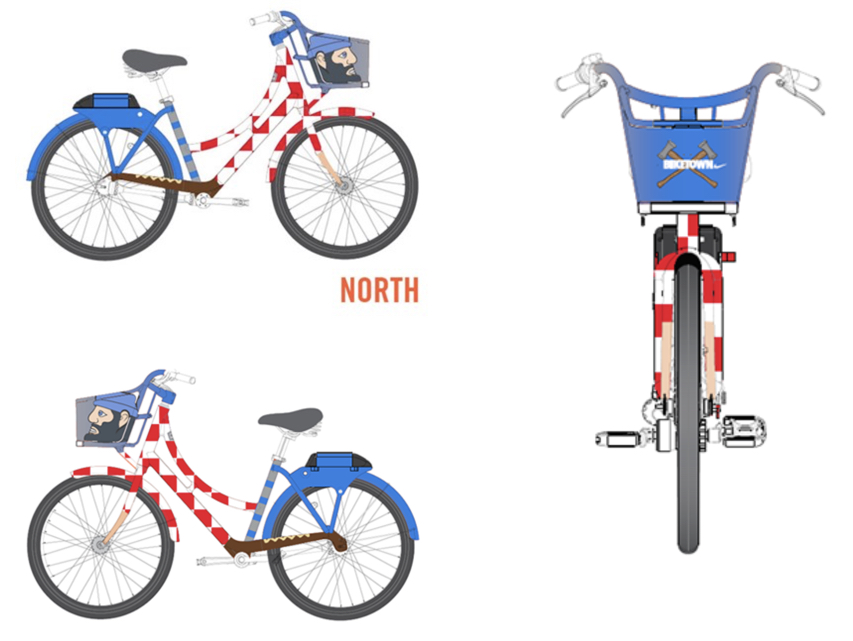
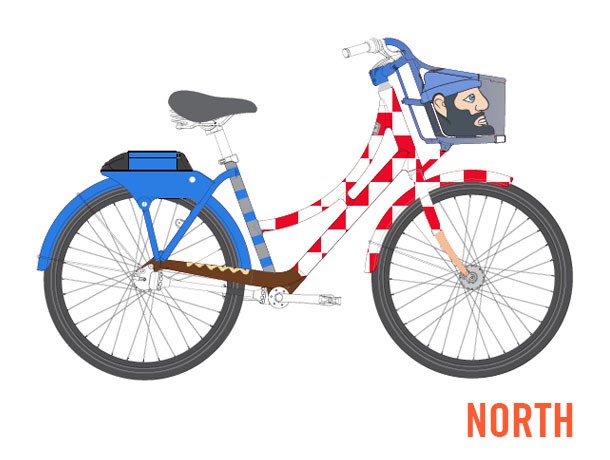
Teresa Bubb’s design is inspired by the Paul Bunyan statue that watches over the Kenton neighborhood in North Portland. See all 15 finalists below.

A panel of judges has picked the finalists in a design competition that will bring new colors to Portland’s fleet of Biketown bikes.

And not it’s time to vote on them.

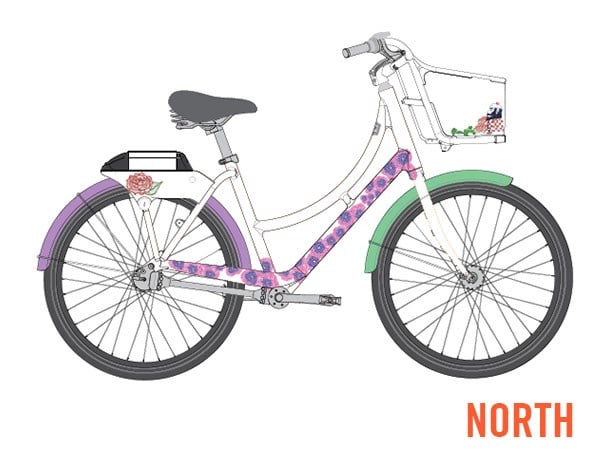
The Biketown Design Challenge kicked off in February and now the best “Show us your Portland” designs have been uploaded to an online gallery. Public voting will determine which one design from each of the city’s five “quadrants” will be added to the fleet via specially-wrapped bikes.

Below are the 15 finalists (three from each of the five quadrants). I’ve also included the artist’s name and their inspiration statement.

North Portland

Explore North Portland
Bridgette Coleman

“I wanted to capture the amazing sights that can be seen while exploring North Portland (The best neighborhood in town).”

Ride, Paul Bunyon, ride!
Teresa Bubb

“Since the Oregon State centennial of 1959, Paul Bunyon has stood patiently, arms crossed, smiling over beloved North Portland. As a North Portland ambassador and fashion trend setter, Paul has personified the region smiling through the winters as easily as the summers. He has contentedly watched over people, dogs, cars, MAX and bikes…..thousands of bikes and bikers. But this year, the 59th year since the 1959 centennial, it is Paul’s time to ride!! Stretch out those concrete arms, roll up the right leg of his skinny jeans and jump on a Nike town bike to the other quadrants of the city. Time to explore this city that has grown up around him. Please help Paul get his bike and ride, Paul Bunyon ride!!!”

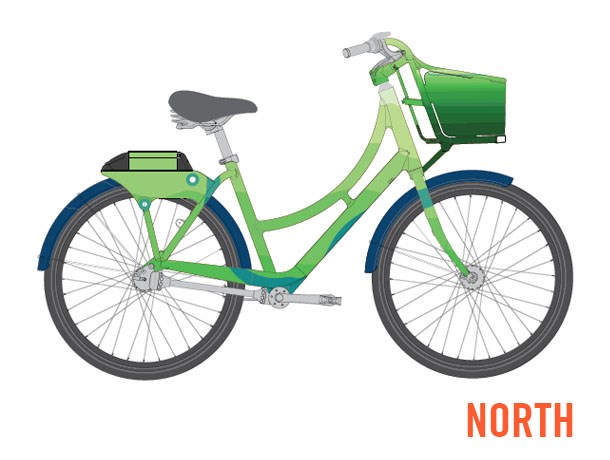
Smith and Bybee
Stevyn Llewellyn

“This design was inspired by one of my personal favorite spots to visit in North Portland, the Smith and Bybee Wetlands Natural Area. The appeal of this place is the lush greenery, tranquil waters and varied wildlife.

The foundation of the design was originally drawn from a map, and my intention was to create an image where the colors and elements serve as a means to draw focus to the appreciation of this special area.”

Advertisement

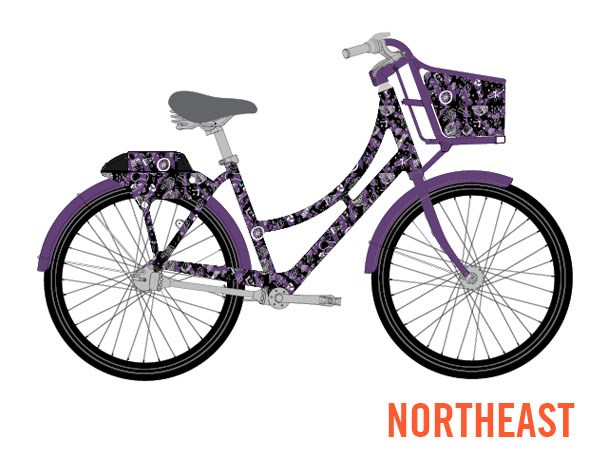
Northeast

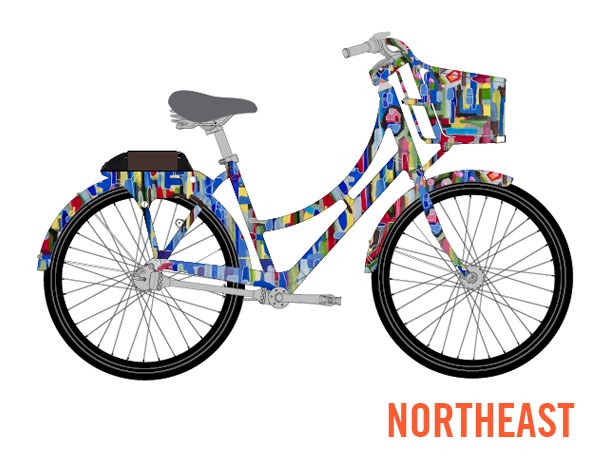
North East Cycling Life
Sean Lambert

“The intersection of city streets adhering to a vague grid system bikes traverse with seemingly greater ease than vehicles has fascinated me since I first called Portland home. The many one way avenues coupled with tricky sight lines give a nearly palatable sense of adventure to all who get behind the wheel or hop on a bike. This same type of “controlled chaos” is reflected in my approach to art. I utilize a structured personal aesthetic along with an explorative color palette to convey movement, balance, and form; the same elements we find in roadways throughout NE Portland. However, what makes any place great is its people. The vitality and energy I put into my art is sustained by the friends and neighbors I’m proud to know throughout Rose City as a whole; they have inspired me to continue to create and design, knowing we can all share in what makes Biketown possible.”

77
Jamon Sin

1977. Historic seasons and team legends. An icon of teamwork, unity, and competition. All in the name of Jack Ramsay. Number 77 forever.

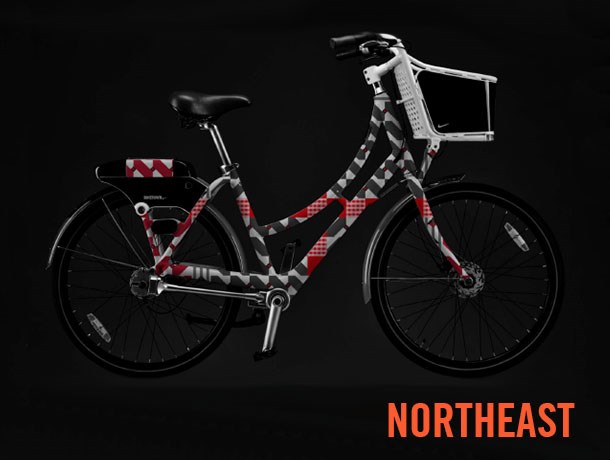
Main & Leading
Chloe Miller & Spencer Groshong

“Inspired by our love of Portland, this pattern was drawn while frequenting many of our favorite establishments around our neighborhood in NE Portland. This design brings together our personal experiences with the city, and aims to communicate how proud we are to be part of Rip City.”


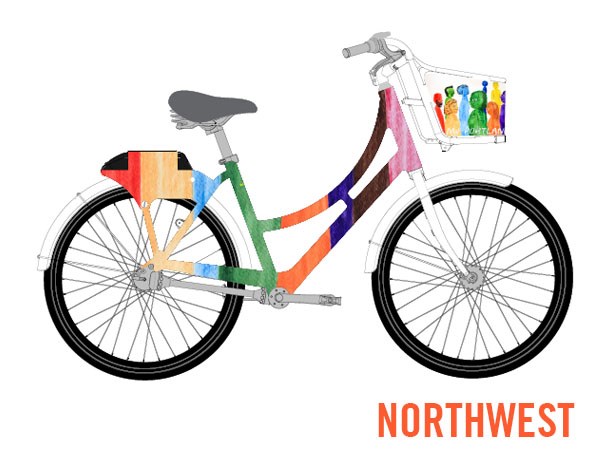
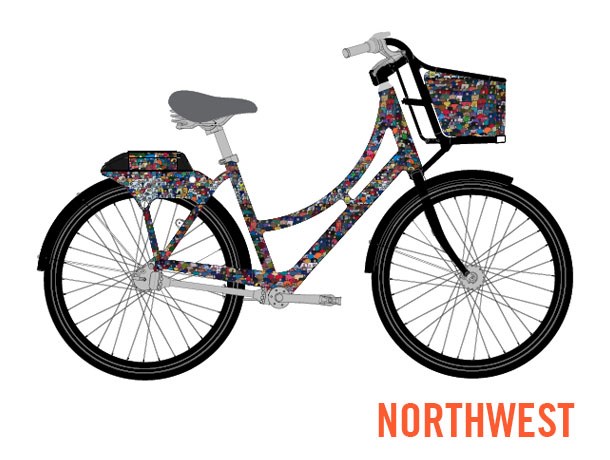
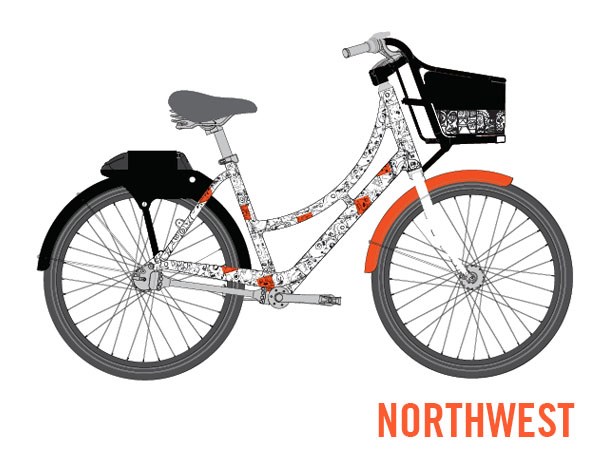
Northwest

Colorful Portland
Renata Castro

“I see Portland as the gathering of several cultures in a multidisciplinary and innovative range in the way people interact and express themselves creatively. And it is these people who were born or who chose to adopt the city that inspired me to translate them in a multicolored way; the essence that I see of a whole.”

Everyday people
Adolph Bastendorff

“The world we live in. I attempt to speak in a universal language in order to reach as many people from around the world as possible. My work is a reflection of the diversity of Portland. This series represents groups of people coming together as one. A group of individuals who decide to live as one community.”

We Live Here
Doug Lloyd

“After living & working all over the city through the last 15 years I’ve found the NW to be the most vibrant and diverse area of Portland. This area is growing more in the metropolitan sense than anywhere else in the state and still making space for creatives and quality Portland strange.

The NW is often passed over by residents on the Eastside of the river. I’ve seen programs like Biketown start to bring even more people to adventure the inner NW areas. Our city was built for bike commuters so facilitating peoples adventures is a great success Biketown has to report.

I regularly notice pairs and groups of tourists on the Biketown bikes in my neighborhood of Old Town. My design is inspired by the many partners who come to our city & grab a bike to beat traffic or for a pedal adventure. The bikes live here & invite people to ride.”


Southeast

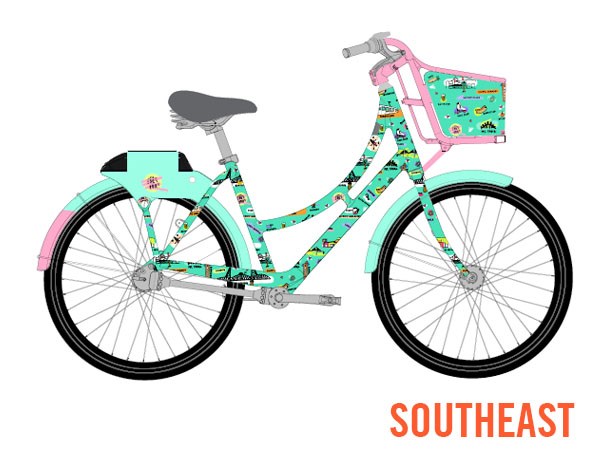
Explorin’ Southeast!
Marguerite Schumm

“How can you sum up all of Southeast Portland into one illustration? By honoring all of it!

Think of all the fun neighborhoods that you can travel to via BIKETOWN: To start you can grab drinks in Brooklyn, bike over to OMSI, head up Hawthorne and catch a film at the Bagdad, head down to Portland Mercado for a bite to eat, maybe later you can watch a sunset on Mount Tabor! The list goes on and on, and this illustration reflects the many beautiful, fun and quirky facets of Southeast Portland!

Let’s hop on a bike and explore it!”

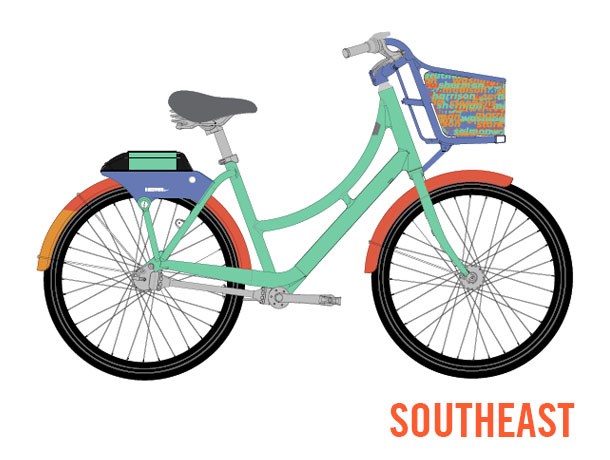
SE Streets
Anthony Abraham

“I’m inspired by the neighborhoods in Southeast Portland, each with unique homes in an array of colors you won’t find anywhere else. To represent this, I’ve created a multicolor collage of all the street names in Biketown’s SE range, layered on top of each other to represent the activity and depth you’ll find when you explore Southeast. The open source font used in this wrap has a forward slant, suggesting movement and travel, and the actual SVG image was created by a script, which will make it easier to export the pattern to fully wrap the bike.”

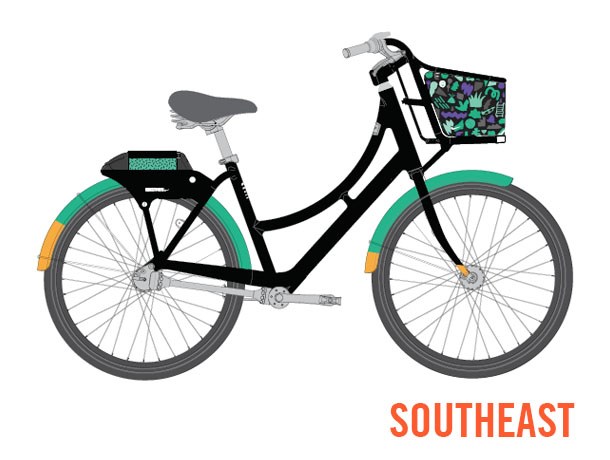
Sunnie
Natassja Pal

“Having grown up in SE Portland, I wanted to create a design that honors the ingenuity that has come from this quadrant of the city while encouraging the rider to consider their own journey and what SE means to them. This bike is named after my father, who immigrated to Portland in the 80s and continues to contribute to its landscape.

I have created two abstract patterns to represent the always changing area of SE. While there are illustrations based on my own experiences in SE (for example, the trumpet is a nod to the late “Working” Kirk Reeves, a true Portland artist), a lot of the design is open to interpretation. When you see an illustration of a carrot, maybe you think of a meal you had at Ava Gene’s, or perhaps of a defunct store like the Daily Grind. Some people will be able to spot the illustration of Fubonn, and some won’t- and that’s ok. This flexibility is intentional and meant to cause the viewer to think about where they are and what they are experiencing. SE Portland has always fostered creative exploration, and this is an invitation for the rider to take part in the process.”


Southwest

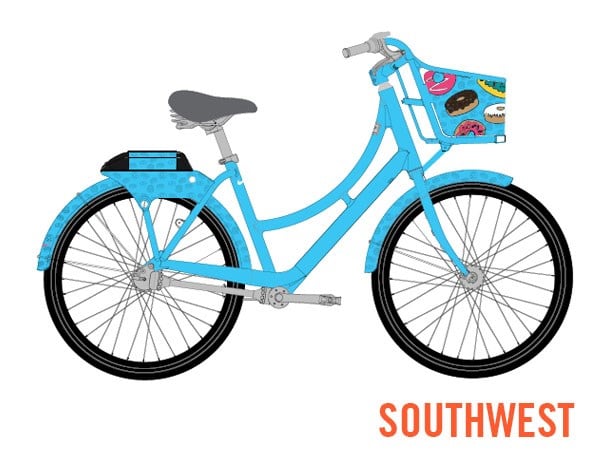
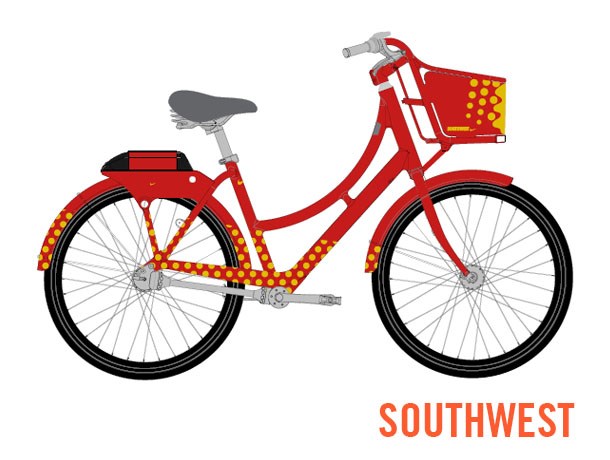
Donut Town
Mark Shimahara

“We all know Portland has some of the world’s best donuts, but where to get them can be divisive. Locals and tourists line up at various locations such as Blue Star and Voodoo in the Southwest for a taste of their favorite treat. This design celebrates Portland donuts, which are as as kooky, colorful and eclectic as Portlanders.”

The Fabric of our Times
Damon Watters

“Having worked in the agency that started the Biketown initiative I felt the initial design was so strong and had such great functional and aesthetic character. Focused on uniting people to be stronger together and harnessing on the ultra-positive festival vibe of summer…”

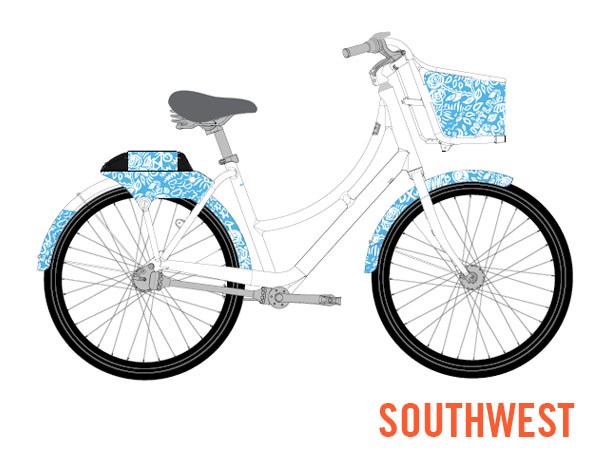
Waterfront Wanderer
Ayla Leisure

“Portland is home to me. I have grown up in Oregon. The main inspiration for my design was to create something that captures what the city means to me, and the things I find beautiful about it. I chose to stick to a blue and white color scheme to compliment the orange BIKETOWN aesthetic. The blue is meant to tie into the water that connects the city, while keeping the imagery simple and relatable.

I made my design so that it could be easily rotated and repeated, or it could be tiled together to contour to the form of the wrap. Additional white graphic elements could also be added as needed to fill gaps, or to showcase more things that I love about the city, while keeping them smaller in size so the elements don’t get lost on the frame of the bike.

I plan to use this design opportunity to weave in symbols the Portland community can make connections to. Hopefully my design will simultaneously capture the modern, weird, active, adventurous, proud, kind and dynamic nature of the city I call home.”

Online voting is open to all Biketown members from today until May 3rd. The winners will be announced shortly thereafer and you can expect to see the designs rolling around Portland this summer.

— Jonathan Maus: (503) 706-8804, @jonathan_maus on Twitter and jonathan@bikeportland.org

Never miss a story. Sign-up for the daily BP Headlines email.

BikePortland needs your support.

The post A Paul Bunyan-themed Biketown bike? Your vote could make it a reality appeared first on BikePortland.org.


from Latest headlines from BikePortland https://ift.tt/2HtrDjB